Compensation & Reward Insights

When should an artificial intelligence skills premium become part of base pay?
RewardEdge Daily Insights

When should an artificial intelligence skills premium become part of base pay?

Artificial intelligence skills are attracting meaningful market premiums, but a market premium does not automatically belong in permanent base pay. This edition examines how Reward leaders can distinguish temporary scarcity from sustained job requirements, separate individual capability from job value, and choose the right pay mechanism. It introduces the RewardEdge Premium Migration Test for deciding when a temporary AI skills premium should become part of long-term salary architecture.
WHEN DOES ORGANISATIONAL FRICTION BECOME A CAPITAL-ALLOCATION PROBLEM?
RewardEdge Daily Insights

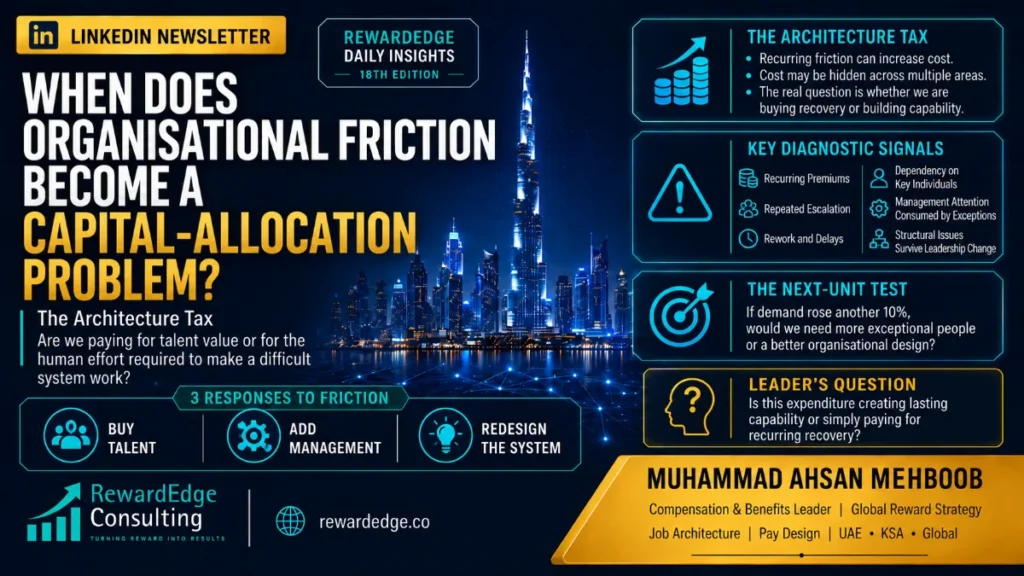
WHEN DOES ORGANISATIONAL FRICTION BECOME A CAPITAL-ALLOCATION PROBLEM?

Recurring organisational friction can look like a people problem, a pay issue or normal complexity, but it may signal a deeper Architecture Tax. This edition explores when organisations keep funding recovery through exceptional people, premiums, escalation, rework and management attention instead of investing in redesign, capability and more repeatable performance.

When Speaking Up Creates More Work
RewardEdge Daily Insights

When Speaking Up Creates More Work

Speaking up should help organisations detect risks early, but voice can become costly when the employee who raises a concern also inherits the investigation, coordination and implementation work. This edition introduces the Voice-to-Workload Gap and explains why post-voice ownership, authority, capacity and Reward consequences must be deliberately designed to keep employee voice sustainable.

WHEN EVERY FUNCTION HITS ITS TARGET AND THE SYSTEM STILL FAILS
RewardEdge Daily Insights

WHEN EVERY FUNCTION HITS ITS TARGET AND THE SYSTEM STILL FAILS

Every function can meet its target while the shared outcome still fails. This edition introduces the Interface Performance Gap and explains how functional KPIs, local optimisation, weak handoffs, hidden interface costs and unclear ownership can damage end-to-end performance. It offers a practical review for leaders designing better performance architecture, accountability and Reward governance.

THE HIDDEN COST OF PERFORMANCE
Reward Intelligence Global

THE HIDDEN COST OF PERFORMANCE

Strong performance is not always economically complete. This edition examines how visible results can conceal overtime, recovery work, rework, turnover, experienced-capability load and future workforce-capacity depletion. It introduces the Performance Cost Attribution Gap and a Capacity-Adjusted Performance Review to help leaders judge whether results are being produced sustainably.

WHEN CRITICAL CAPABILITY BECOMES ORGANISATIONAL DEPENDENCY
RewardEdge Daily Insights

WHEN CRITICAL CAPABILITY BECOMES ORGANISATIONAL DEPENDENCY

Critical capability does not automatically become organisational capability. This edition examines how expertise, judgement, relationships and decision authority can become concentrated in one person or role, creating organisational dependency. It introduces a practical lens for testing whether capability is becoming accessible, sustainable and governable through workforce design, knowledge transfer, job architecture and Reward governance.

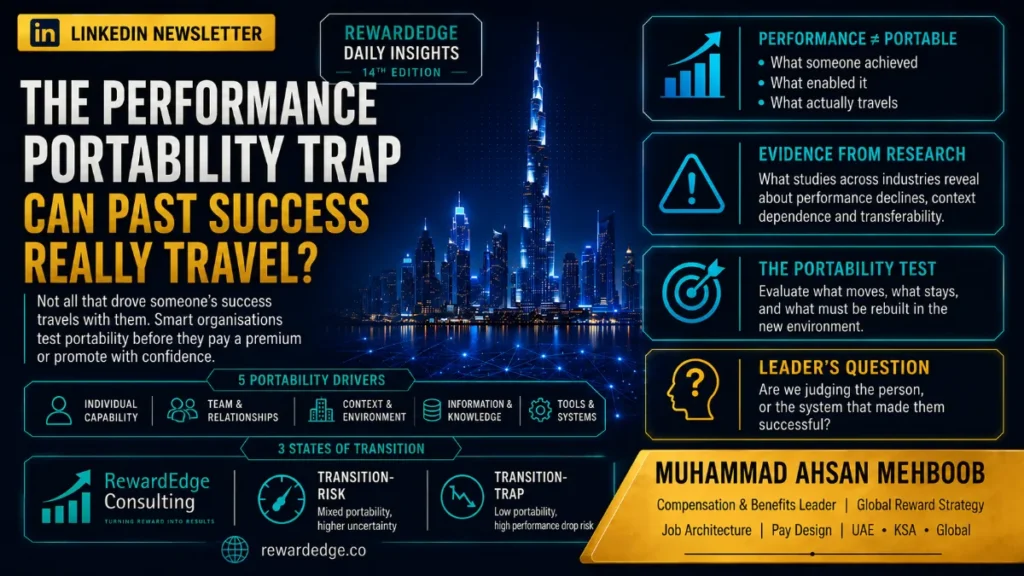
THE PERFORMANCE PORTABILITY TRAP
RewardEdge Daily Insights

THE PERFORMANCE PORTABILITY TRAP

Past performance is valuable evidence, but it is not always fully portable. This edition examines how individual capability, organisational context, relationships, systems, authority and transition friction shape whether a high performer can reproduce success in a new environment. It introduces a practical Performance Portability Review for hiring, promotion, succession, onboarding and Reward decisions.

External Leverage: Is Your Pay System Teaching Employees to Test the Market?
RewardEdge Daily Insights

External Leverage: Is Your Pay System Teaching Employees to Test the Market?

When credible internal pay evidence creates limited action but an external offer triggers urgent salary review, the organisation may be teaching employees to test the market. This edition explores the External Leverage Loop, counteroffer governance, internal equity, role-value integrity, salary review triggers and how stronger pay governance can address issues before resignation creates urgency.

The Trigger Authority Gap: Who Has the Right to Put a Decision Back Under Review?
RewardEdge Daily Insights

The Trigger Authority Gap: Who Has the Right to Put a Decision Back Under Review?

Organisations can detect change, collect evidence and still fail to act when nobody has clear authority to require a decision review. This edition introduces the Trigger Authority Gap and explains why signals, evidence, triggers, reviews and decisions must be clearly connected through governance, materiality thresholds, review rights and decision traceability.

When the Market Moves Faster Than Your Pay Cycle
RewardEdge Daily Insights

When the Market Moves Faster Than Your Pay Cycle

When labour markets move faster than annual salary reviews, organisations can miss material changes in market pay, hiring pressure, incumbent positioning and pay compression. This edition introduces Pay Cadence Risk and explains how stronger market monitoring, salary-structure governance, comparator discipline and intervention rules can help organisations make better pay decisions before the calendar decides by default.

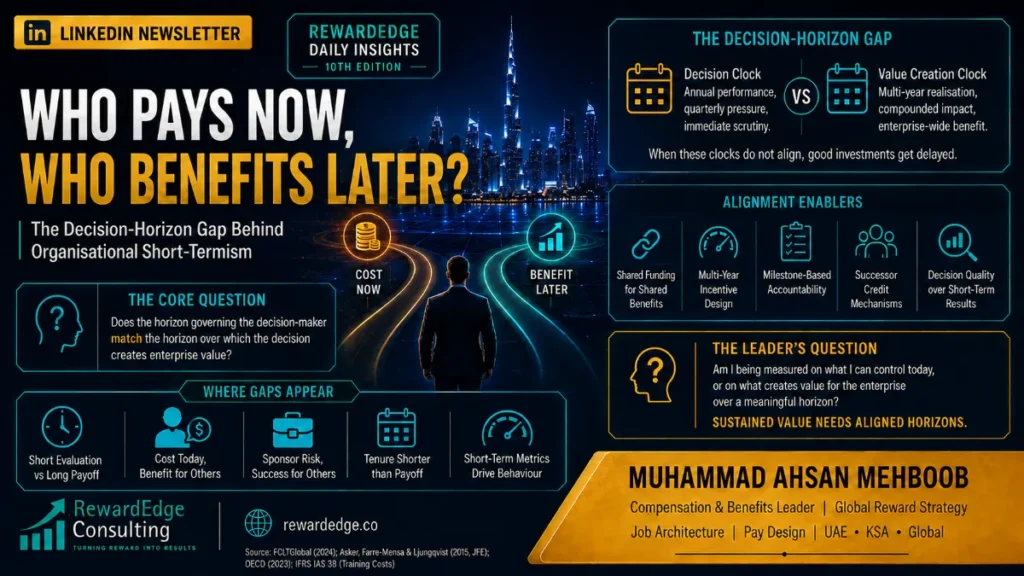
Who Pays Now, Who Benefits Later?
RewardEdge Daily Insights

Who Pays Now, Who Benefits Later?

Organisations often call delayed investment a leadership problem, but the real issue may be decision architecture. When one leader pays today, another function benefits later, and performance is judged on a shorter clock than value creation, rational leaders may delay enterprise-positive decisions. This edition explores the Decision-Horizon Gap behind organisational short-termism.

Scroll to Top