Reward Intelligence Global

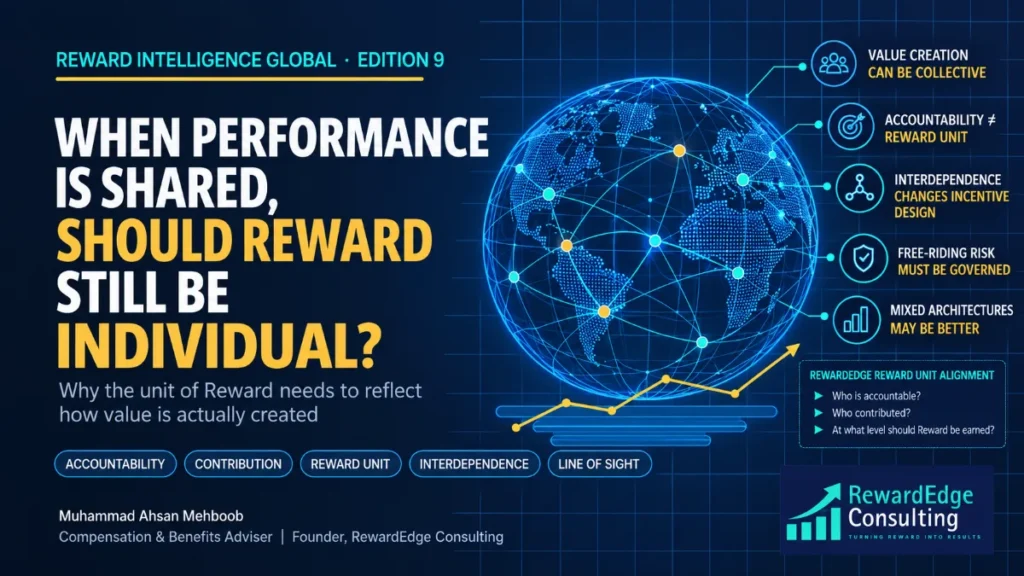
When performance is shared, should Reward still be individual?
Reward Intelligence Global

When performance is shared, should Reward still be individual?

When performance is shared across teams, functions and business units, should financial Reward still remain primarily individual? This edition introduces Reward Unit Alignment, a practical framework for determining where incentives should sit based on value creation, task interdependence, contribution separability, line of sight, free-riding risk and governance. It examines current research, field evidence and practical implications for designing individual, team, enterprise and mixed Reward architectures.

When does pay compression become a workforce risk?
Reward Intelligence Global

When does pay compression become a workforce risk?

Pay compression does not automatically signal poor Reward design. The real risk begins when narrowing pay relationships lose economic meaning, persist without clear rationale, or start influencing retention, progression, internal mobility and leadership decisions. Edition 8 explores the causes of compression, why rational pay decisions can create unintended outcomes, and introduces the RewardEdge Compression Risk Test for determining when intervention is justified.

THE HIDDEN COST OF PERFORMANCE
Reward Intelligence Global

THE HIDDEN COST OF PERFORMANCE

Strong performance is not always economically complete. This edition examines how visible results can conceal overtime, recovery work, rework, turnover, experienced-capability load and future workforce-capacity depletion. It introduces the Performance Cost Attribution Gap and a Capacity-Adjusted Performance Review to help leaders judge whether results are being produced sustainably.

Retention Pay: Protecting Talent or Subsidising Dependency?
Reward Intelligence Global

Retention Pay: Protecting Talent or Subsidising Dependency?

A retention premium can protect genuinely scarce, business-critical talent, or it can quietly subsidise organisational dependency the company created itself — and most retention decisions never separate the two. This edition introduces the Retention Premium Governance Test, six questions covering market scarcity, business criticality, dependency concentration, succession, replacement economics, and premium governance, drawing on WTW, Aon, Mercer, and PwC 2026 data, to help Reward and HR leaders decide what risk they are actually paying to protect.

CAREER GROWTH AND REWARD ARE SENDING DIFFERENT SIGNALS. THAT IS A RETENTION RISK.
Reward Intelligence Global

CAREER GROWTH AND REWARD ARE SENDING DIFFERENT SIGNALS. THAT IS A RETENTION RISK.

Career growth and Reward architecture are sending employees different signals, and WorldatWork’s 2026 State of Rewards found career development is a stronger predictor of retention intent than compensation and benefits, even though only 44% of respondents plan to stay with their employer. This edition introduces the Career-Reward Signal Alignment Test, five signals covering growth, role, progression, Reward, and explanation, to help HR and Reward leaders align career architecture, job architecture, and pay before conflicting signals become a retention risk.

AI Can Accelerate Reward Decisions. It Cannot Own Reward Accountability.
Reward Intelligence Global

AI Can Accelerate Reward Decisions. It Cannot Own Reward Accountability.

AI-driven Reward and compensation decisions are accelerating fast, but OECD research across 6,000+ firms shows managers still can’t explain the accountability behind algorithmic pay recommendations. This piece introduces the Reward AI Accountability Framework — five governance tests covering purpose boundary, data integrity, explainability, decision rights, and audit trail — for organizations using AI in salary reviews, job matching, and pay decisions under the EU AI Act’s high-risk classification rules.

Pay Transparency Is Becoming a Job Architecture Test
Reward Intelligence Global

Pay Transparency Is Becoming a Job Architecture Test

Pay transparency is usually treated as a disclosure project — publish the ranges, brief the managers, move on. In practice, it functions as a public audit of the organisation’s entire job and pay architecture. This piece introduces the Pay Transparency Architecture Test, a five-part readiness framework covering job clarity, grade integrity, range governance, exception discipline, and manager explanation capability — and examines what the research actually supports, and what it doesn’t.

Scroll to Top