Compensation & Reward Insights

AI Is Making Performance Easier to Produce and Harder to Prove
RewardEdge Daily Insights

AI Is Making Performance Easier to Produce and Harder to Prove

AI-assisted output is easier to produce than ever, but employee capability is now harder to prove — Microsoft and Carnegie Mellon research shows higher confidence in AI is linked to less critical thinking, weakening output quality as evidence of underlying competence. This piece introduces the AI-Assisted Capability Evidence Test, six questions covering explanation, verification, transfer, challenge, judgement, and ownership, to separate genuine capability from polished AI-assisted work before it influences performance ratings, promotion, and pay.

ERP Implementations Do Not Fail at Go-Live. They Fail Before Configuration Begins.
RewardEdge Daily Insights

ERP Implementations Do Not Fail at Go-Live. They Fail Before Configuration Begins.

ERP implementation failure is a governance problem, not a technology one — Panorama Consulting’s 2026 ERP Report found operating-model benefits fail most often where leadership shows inertia around decision rights, incentives, and performance metrics. This piece introduces the Eight Foundations of a Successful ERP Go-Live framework, covering data ownership, decision rights, and readiness testing, and explains why deferred business decisions become permanent system behavior long before go-live.

Transformation Fails When Reward Still Pays for the Old Operating Model
RewardEdge Daily Insights

Transformation Fails When Reward Still Pays for the Old Operating Model

Transformations fail when reward systems still pay for the old operating model — McKinsey’s December 2025 research found only 10% of nearly 100 transformations analyzed prioritized accountability, the behavior most linked to financial incentives and consequence management. This piece introduces the Reward Alignment Test, five questions covering behavior, measurement, role architecture, reward consequences, and governance, to diagnose whether your compensation system is reinforcing change or quietly blocking it.

AI Can Accelerate Reward Decisions. It Cannot Own Reward Accountability.
Reward Intelligence Global

AI Can Accelerate Reward Decisions. It Cannot Own Reward Accountability.

AI-driven Reward and compensation decisions are accelerating fast, but OECD research across 6,000+ firms shows managers still can’t explain the accountability behind algorithmic pay recommendations. This piece introduces the Reward AI Accountability Framework — five governance tests covering purpose boundary, data integrity, explainability, decision rights, and audit trail — for organizations using AI in salary reviews, job matching, and pay decisions under the EU AI Act’s high-risk classification rules.

Remote Work Doesn’t Have a Productivity Problem. It Has an Evidence Problem.
RewardEdge Daily Insights

Remote Work Doesn’t Have a Productivity Problem. It Has an Evidence Problem.

Remote work performance evidence is now conclusive: a Nature-published randomized controlled trial found hybrid work has no effect on performance grades or promotions. So why does remote work productivity anxiety persist? This piece introduces the Remote Outcome Evidence Test — four governance questions that reveal whether your organization manages hybrid and remote teams by evidence or by visibility alone.

Broadbanding Didn’t Remove Inequity From Pay Structures. It Just Made It Harder to See
RewardEdge Daily Insights

Broadbanding Didn’t Remove Inequity From Pay Structures. It Just Made It Harder to See

Broadbanding is marketed as the fix for rigid, promotion-dependent pay structures — but collapsing 15–20 narrow grades into 4–8 wide bands doesn’t remove the equity risk built into traditional grading. It removes the boundaries that used to make that risk visible. This piece breaks down what disappears when the grade checkpoint goes, and what has to replace it.

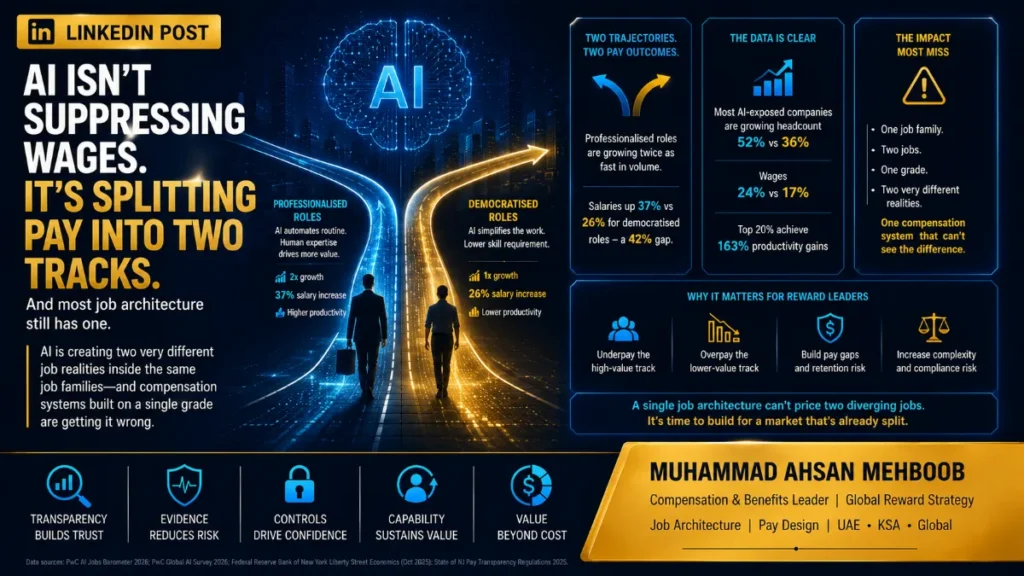
AI Isn’t Suppressing Wages. It’s Splitting Pay Into Two Tracks, and Most Job Architecture Still Has One
RewardEdge Daily Insights

AI Isn’t Suppressing Wages. It’s Splitting Pay Into Two Tracks, and Most Job Architecture Still Has One

AI isn’t flattening pay the way automation fears predicted — it’s splitting it into two tracks. PwC’s 2026 data shows “professionalised” roles pulling ahead in both jobs and wages while “democratised” roles fall behind, and most job architecture still prices both under one grading spine. This piece breaks down why that spine is systematically underpaying the track pulling ahead and overpaying the one that isn’t — and what to do about it.

The Two Words "Good Faith" Are Becoming Comp’s Biggest Undocumented Liability
RewardEdge Daily Insights

The Two Words “Good Faith” Are Becoming Comp’s Biggest Undocumented Liability

Seventeen states now require salary ranges in job postings, but “good faith” has no enforced methodology behind it — meaning most employers are complying with the letter of the law while the number itself remains exactly as arbitrary as before. This piece breaks down the mechanism: what “good faith” actually requires, the one state that tried to prescribe more, and why the EU just set a materially higher bar than any US statute.

Boards Just Redefined "Performance Pay" Without Changing What Executives Have to Deliver
RewardEdge Daily Insights

Boards Just Redefined “Performance Pay” Without Changing What Executives Have to Deliver

ISS’s 2026 policy update now scores long-vesting, time-based equity as a positive factor in pay-for-performance review — the same treatment once reserved for genuine performance conditions. This piece breaks down what actually changed, the service-condition-versus-performance-condition distinction boards are quietly exploiting, and what the early 2026 proxy data already shows.

Pay Transparency Is Becoming a Job Architecture Test
Reward Intelligence Global

Pay Transparency Is Becoming a Job Architecture Test

Pay transparency is usually treated as a disclosure project — publish the ranges, brief the managers, move on. In practice, it functions as a public audit of the organisation’s entire job and pay architecture. This piece introduces the Pay Transparency Architecture Test, a five-part readiness framework covering job clarity, grade integrity, range governance, exception discipline, and manager explanation capability — and examines what the research actually supports, and what it doesn’t.

Capability Risk Due Diligence: The Missing People Test Before Strategy Is Approve
RewardEdge Daily Insights

Capability Risk Due Diligence: The Missing People Test Before Strategy Is Approve

Most organisations skip capability risk due diligence before approving strategy — BCG’s 2026 research across 7,000+ leaders found only 11% have an enterprise-wide skills architecture, despite workforce planning ranking the #2 global priority. This piece introduces the RewardEdge Capability Risk Due Diligence Framework, an eight-dimension test covering leadership bench readiness, critical role coverage, decision rights, and reward alignment — the missing people test every board should run before committing to strategy.

Pay Gap Reporting Won’t Stop at Gender
RewardEdge Daily Insights

Pay Gap Reporting Won’t Stop at Gender

UK pay gap reporting is expanding beyond gender — the government confirmed in March 2026 it will extend mandatory reporting to ethnicity and disability, using the same calculation machinery already built for gender pay gaps. This piece argues the reporting perimeter is axis-agnostic and will keep expanding, examines what ONS ethnicity pay gap data actually reveals once disaggregated, and explains why job evaluation — not smaller gaps — is the only durable defence once the audit reaches your organisation.

Scroll to Top