Salary range overlap is often treated as though it were a design defect.
It is not.
In a conventional graded salary structure, adjacent pay ranges will often share part of the same salary territory. An experienced employee near the top of a lower grade may therefore earn more than an employee who has only recently entered the grade above.
That outcome does not automatically mean the grading structure is wrong, the promotion system has failed or internal equity has been lost.
The more useful questions are:
Why do the ranges overlap?
How much overlap has the structure created?
Does that overlap still preserve meaningful differences between adjacent grades?
Can the organisation explain salary decisions made inside the shared territory?
Salary range overlap should therefore be interpreted as part of the wider compensation architecture—not as an isolated percentage.
A defensible assessment needs to consider range width, midpoint progression, job architecture, promotion economics and pay governance together.
For practitioners reviewing the wider design of grades, ranges and pay decisions, the RewardEdge Publications library provides the broader framework behind RewardEdge’s compensation work.
Table of Contents

What is salary range overlap?
Salary range overlap is the portion of one salary range that is also contained within an adjacent salary range.
Consider two grades:
| Grade | Minimum | Midpoint | Maximum |
|---|---|---|---|
| Grade 5 | 60,000 | 75,000 | 90,000 |
| Grade 6 | 75,000 | 90,000 | 105,000 |
Grade 5 ends at 90,000.
Grade 6 begins at 75,000.
The salary territory between 75,000 and 90,000 therefore exists in both grades.
That is the overlap.
The overlap does not mean Grade 5 and Grade 6 represent equivalent work.
The grade should reflect the relative value, scope or level of the job.
The employee’s salary position reflects a different question: where should that particular employee be paid within the opportunity created for the grade?
That distinction matters because a highly experienced Grade 5 employee may reasonably be positioned near the top of Grade 5 while a newly promoted or newly hired Grade 6 employee may enter near the lower part of Grade 6.
Their salaries may cross.
Their job levels have not necessarily crossed.
How to calculate salary range overlap
A useful way to quantify overlap is:
Salary range overlap % =
(Lower-grade maximum − Higher-grade minimum) ÷
(Higher-grade maximum − Higher-grade minimum) × 100
ERI uses this approach in its compensation formulas.
Using the example above:
Lower-grade maximum = 90,000
Higher-grade minimum = 75,000
Higher-grade maximum = 105,000
Shared salary territory:
90,000 − 75,000 = 15,000
Width of the higher-grade range:
105,000 − 75,000 = 30,000
Therefore:
15,000 ÷ 30,000 × 100 = 50% overlap
So half of the Grade 6 range is also contained within Grade 5.
This is useful information.
It is not yet a design conclusion.
The percentage tells us how much the ranges overlap. It does not, by itself, tell us whether that amount is appropriate for the organisation.
A practical caution about overlap percentages
Practitioners should also state which overlap formula they are using.
Different calculations can use different denominators, which means two people can describe the same salary structure using different percentages.
For governance purposes, consistency matters more than arguing over the denominator: choose a methodology, document it and use it consistently across the structure.
Measuring salary range overlap consistently across adjacent grades makes it easier to identify structural anomalies rather than reacting to one isolated range.
Why salary ranges overlap in the first place
Overlap exists because salary structures normally need to recognise two different things simultaneously.
The first is differences between jobs.
The second is differences between employees performing jobs at a given level.
If every employee in the higher grade had to earn more than every employee in the lower grade, salary ranges would need to operate more like discrete steps.
That would reduce the organisation’s ability to recognise meaningful differences in experience, contribution, capability or market position within the same grade.
Controlled overlap creates room for both dimensions.
An experienced professional can continue progressing within a grade without requiring a promotion merely to receive higher pay.
At the same time, an employee can enter a larger job in the next grade without the organisation being forced into an artificially large salary increase simply to clear the previous grade maximum.
WorldatWork describes range spread, midpoint differentials and range overlap as connected components of base-pay structure design rather than independent features. Recent WorldatWork guidance also notes that range width should reflect factors such as variation in job scope and experience, expected time within a level and the desired relationship between adjacent ranges.
The design objective is therefore not to eliminate overlap.
It is to create controlled overlap for a reason.
Range width is one driver of salary range overlap
The wider a salary range becomes, the more salary territory it can potentially share with neighbouring grades.
Suppose two grades have these ranges:
Grade A: 64,000–96,000
Grade B: 73,600–110,400
Both have a 50% range spread when range spread is expressed as the distance from minimum to maximum relative to minimum.
The ranges overlap from 73,600 to 96,000.
That is substantial shared territory.
Wider ranges can be completely legitimate.
They may be appropriate where:
- employees can remain at the same organisational level for a long time;
- significant capability growth can occur without changing job level;
- roles within the grade have meaningful market variation;
- the organisation deliberately uses fewer, broader grades.
But widening a range has consequences.
The organisation is effectively giving managers and Reward teams more space in which to differentiate employee salaries.
The wider that space becomes, the stronger the progression rules and governance usually need to be.
A wide range without a clear philosophy for salary positioning can create discretion faster than it creates flexibility.
Midpoint progression is the other major driver
Range width is only half of the overlap story.
The other major variable is midpoint progression: the percentage movement from the midpoint of one grade to the midpoint of the next.
Consider two structures with the same range spread.
Structure A — 50% range spread, 15% midpoint progression
Grade 5 midpoint = 80,000
Grade 6 midpoint = 92,000
Approximate ranges:
Grade 5 = 64,000–96,000
Grade 6 = 73,600–110,400
Overlap:
(96,000 − 73,600) ÷ (110,400 − 73,600) ≈ 61%
Structure B — 50% range spread, 25% midpoint progression
Grade 5 midpoint = 80,000
Grade 6 midpoint = 100,000
Approximate ranges:
Grade 5 = 64,000–96,000
Grade 6 = 80,000–120,000
Overlap:
(96,000 − 80,000) ÷ (120,000 − 80,000) = 40%
Nothing happened to the range spread.
The ranges became less overlapping because the distance between the grade midpoints increased.
That is why diagnosing overlap without looking at midpoint progression can produce the wrong conclusion.
Historical WorldatWork/SHRM research has also shown that structure types use materially different combinations of range spread and midpoint progression; traditional, market-based and broadband structures are not built around the same geometry.
The relationship matters more than either number alone
The core design relationship can therefore be expressed simply:
Wider ranges + smaller midpoint progression = more overlap
Narrower ranges + larger midpoint progression = less overlap
That relationship is much more useful than asking whether a particular overlap percentage is universally good or bad.
Suppose an organisation finds 70% overlap between two adjacent grades.
That could have several explanations:
- The ranges may be intentionally wide.
- The midpoint progression may be too small.
- The organisation may have created too many grades.
- Market rates for the jobs may be genuinely close.
- The job architecture may not differentiate the grades strongly enough.
- The structure may have evolved through historical adjustments rather than deliberate design.
The calculation tells you where to investigate.
It does not tell you automatically what to change.
When overlap is legitimate
Salary range overlap is normally easier to defend when four conditions are present.
1. The adjacent grades represent genuinely different levels of work
The organisation should be able to explain what changes from one grade to the next.
That might include:
- decision authority;
- complexity;
- organisational scope;
- financial accountability;
- problem-solving demands;
- leadership responsibility;
- depth of expertise;
- impact of decisions.
If the only explanation for the grade difference is that one group happens to be paid more, the structure has a deeper problem.
Grade architecture should drive the pay structure—not the other way around.
2. The overlap supports legitimate progression within a grade
An employee should not need a title change or artificial promotion simply because their salary has progressed.
Some overlap allows experienced employees to continue developing economically within their current level.
This can be especially valuable for professional or specialist careers where capability can deepen considerably without the job becoming a higher-level role.
WorldatWork has noted the value of controlled range overlap in allowing experienced and skilled employees to progress without requiring promotion where there is no underlying business case for one.
3. Promotion still produces a credible transition
Overlap should not make promotion economically meaningless.
If an employee moves into a genuinely larger job but the relationship between the two ranges leaves almost no room to recognise that change, the structure deserves examination.
That does not mean every promotion requires a large fixed percentage increase.
It means the organisation should be able to determine an appropriate position in the new range while recognising the increased level of work.
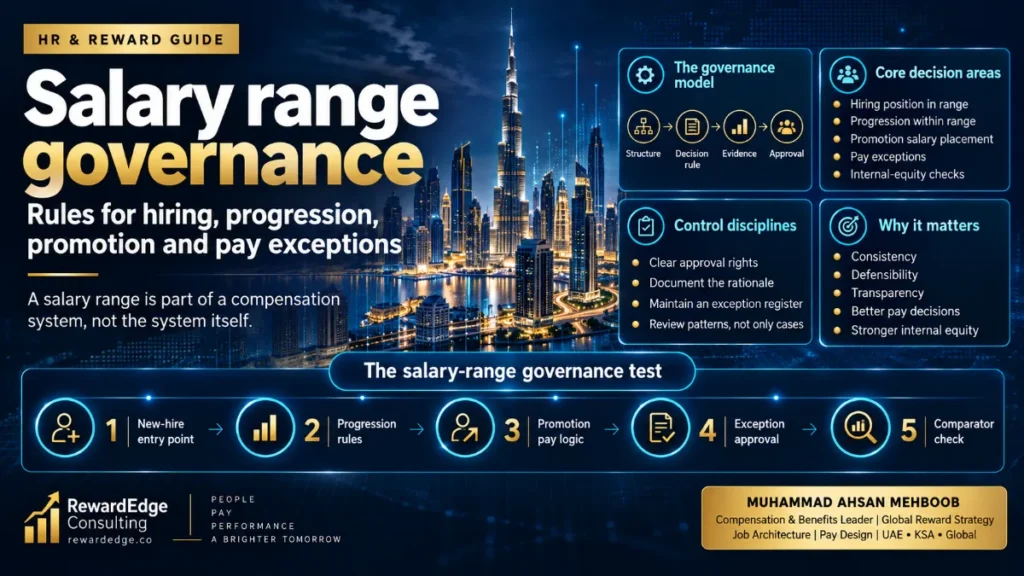
RewardEdge’s existing Salary Range Governance: Rules for Hiring, Progression, Promotion and Pay Exceptions should be internally linked here rather than recreating its full promotion methodology.
4. Salary differences inside the overlap can be explained
Imagine:
An experienced Grade 5 specialist earns 92,000.
A newly promoted Grade 6 employee earns 88,000.
The lower-grade employee earns more.
That is not automatically inequitable.
The organisation may be able to explain the difference through relevant experience, sustained contribution, specialist capability, market positioning or the higher-grade employee’s recent entry into the role.
The test is not:
Which grade has the higher-paid employee?
It is:
Can the salary relationship be explained consistently within the organisation’s compensation philosophy?
When does overlap become excessive?
Salary range overlap becomes more concerning when it starts weakening the intended economic distinction between adjacent grades.
There is no universal percentage at which overlap suddenly becomes structurally wrong.
ERI’s guidance characterises 50–60% overlap as moderate for a typical salary structure and warns that substantial overlap can occur where there are too many grades or insufficient market-rate differentiation. That is a useful practitioner reference point, but it should not be treated as a universal design law.
Structure type, workforce model, job architecture and career philosophy matter.
The better test is whether the overlap begins creating identifiable structural consequences.
Signal 1: adjacent grades become difficult to distinguish
Ask managers to explain the difference between two neighbouring grades.
If they can explain it through work content, accountability and job value, overlap may be functioning normally.
If they answer mainly with:
“Grade 8 pays more than Grade 7,”
the structure is weak.
A grade is supposed to represent a level of work.
Its existence should not depend on the pay range being visibly separated from the grade below.
Signal 2: the same salary territory spans several grades
Overlap between two adjacent grades can be normal.
Heavy overlap across three, four or five levels should trigger a different question.
For example:
Grade 5: 60,000–90,000
Grade 6: 70,000–100,000
Grade 7: 80,000–110,000
Grade 8: 90,000–120,000
A salary of 90,000 could potentially sit in four different grades.
That does not automatically make the structure invalid.
But the organisation should be able to explain why four distinct job levels require such similar economic territory.
If it cannot, possible causes include:
- too many grades;
- weak midpoint progression;
- ranges that are unnecessarily wide;
- insufficient job differentiation;
- historical grade proliferation;
- inconsistent market pricing.
This is where overlap becomes an architectural diagnostic rather than just a compensation calculation.
Signal 3: promotion differentiation becomes difficult to sustain
Suppose Grade 5 and Grade 6 overlap heavily.
An experienced Grade 5 employee earns 95,000.
The employee is promoted into Grade 6, whose range is 80,000–110,000.
The existing salary is already well inside the new range.
The organisation now has to decide whether the employee should:
- remain at 95,000;
- receive a promotion increase;
- move to a specific target position;
- be compared with existing Grade 6 incumbents;
- receive some combination of role-change recognition and internal-equity adjustment.
Overlap has not caused the problem.
It has exposed the need for a promotion-pay policy.
But if this happens repeatedly across the structure and genuine increases in responsibility rarely produce meaningful pay differentiation, the organisation should reconsider the relationship between the grades.
Signal 4: salary starts determining grade
One of the clearest warning signs is reverse engineering.
A manager says:
“This employee earns 105,000, and that salary sits in Grade 7, so the employee should be Grade 7.”
That is weak architecture.
Salary history can be influenced by many things:
- market premiums;
- retention adjustments;
- historical decisions;
- previous employers;
- hiring negotiations;
- performance;
- scarce skills;
- pay exceptions.
Those factors can affect employee pay.
They should not automatically redefine the value of the job.
The correct sequence is:
Evaluate the job → determine the grade → govern the employee’s salary within that architecture.
Not:
Observe the salary → infer the grade.
Signal 5: overlap is being used to hide weak job architecture
Sometimes the problem attributed to the salary structure is actually upstream.
If the distinction between jobs is vague, adjusting the ranges will not fix it.
A company can reduce overlap mathematically by increasing midpoint progression.
The spreadsheet will look cleaner.
But if the Grade 6 and Grade 7 jobs still cannot be differentiated in terms of scope, complexity or accountability, the underlying architecture remains weak.
That is why overlap should be interpreted alongside job architecture.
RewardEdge’s Job Architecture: A Practitioner’s Guide is the appropriate internal supporting resource here.
Salary range overlap is not pay compression
These terms are often confused.
They describe different things.
Salary range overlap is a property of the structure.
It tells us how much salary territory is shared by adjacent ranges.
Pay compression is a property of actual employee pay relationships.
It describes situations where differences in employee pay have become unusually narrow relative to experience, responsibility, tenure or hierarchy.
An organisation can have significant range overlap but no problematic pay compression.
For example, the ranges may intentionally overlap while employee salaries remain appropriately differentiated.
Conversely, the ranges may be well designed but repeated high new-hire salaries can still create compression among actual employees.
Do not redesign salary ranges merely because employee pay has compressed.
First determine whether the problem lies in:
- the ranges;
- hiring decisions;
- progression;
- promotion policy;
- market movement;
- retention interventions;
- or governance.
That distinction protects the organisation from using structural redesign to solve an operating problem.
Salary range overlap is also not broadbanding
Traditional overlapping salary ranges and broadband structures should not be treated as the same thing.
A conventional structure may contain several grades with controlled overlap between each adjacent pair.
Broadbanding intentionally collapses many of those grade boundaries into a much smaller number of very wide salary bands.
Historical WorldatWork data described broadband structures as having far wider range spreads than traditional or market-based structures.
The governance implications are different.
A broad band provides much more room for salary movement without a grade change.
That flexibility can be useful.
It also places more pressure on the organisation to explain why employees occupy materially different salary positions inside the same broad band.
RewardEdge has already examined that issue in Broadbanding Didn’t Remove Inequity From Pay Structures. It Just Made It Harder to See.
This article should therefore remain focused on overlap between adjacent ranges, not become another broadbanding article.
A three-grade worked example
Consider this salary structure:
| Grade | Minimum | Midpoint | Maximum | Range spread |
|---|---|---|---|---|
| Grade 5 | 60,000 | 75,000 | 90,000 | 50% |
| Grade 6 | 75,000 | 93,750 | 112,500 | 50% |
| Grade 7 | 93,750 | 117,188 | 140,625 | 50% |
The midpoint progression is approximately 25% from one grade to the next.
Grade 5 to Grade 6
Shared territory:
90,000 − 75,000 = 15,000
Grade 6 range width:
112,500 − 75,000 = 37,500
Overlap:
15,000 ÷ 37,500 = 40%
Grade 6 to Grade 7
Shared territory:
112,500 − 93,750 = 18,750
Grade 7 range width:
140,625 − 93,750 = 46,875
Overlap:
18,750 ÷ 46,875 = 40%
The structure has intentional, consistent overlap.
That consistency is useful because the same architecture is being applied across neighbouring grades.
Now imagine Grade 7 had instead been set at:
80,000–140,000
The relationship would change dramatically.
That one grade would overlap extensively with Grade 6 and potentially begin encroaching on Grade 5 salary territory.
The correct question would not simply be:
“Is the overlap percentage too high?”
It would be:
“Why is Grade 7 structurally different from the rest of the architecture?”
Perhaps the market requires it.
Perhaps Grade 7 contains unusually diverse jobs.
Perhaps it was created historically.
Perhaps its range was widened to solve employee-pay problems that should have been addressed another way.
The anomaly is a signal to investigate.
The RewardEdge Salary Range Overlap Test
Rather than relying on one benchmark percentage, organisations can use a six-part diagnostic.
1. Job-level differentiation
Can we explain why the adjacent grades represent different levels of work?
Review accountabilities, scope, complexity, decision-making and job value.
If the jobs are not meaningfully differentiated, changing salary overlap is unlikely to fix the underlying problem.
2. Range-width logic
Why are the ranges as wide as they are?
Range width should have a purpose.
It may reflect career maturity, workforce diversity, market variation or a deliberate structural philosophy.
If nobody can explain why the spread is 40%, 50%, 70% or 100%, the structure may be inherited rather than designed.
3. Midpoint-progression logic
Does the difference between adjacent midpoints reflect the intended economic distinction between the grades?
Small midpoint progression combined with wide ranges will naturally create more overlap.
Before reducing overlap, determine whether the real issue is range width, midpoint progression or both.
4. Overlap concentration
Does substantial overlap occur only between neighbouring grades, or does the same salary territory stretch across several levels?
Overlap confined primarily to adjacent grades is easier to explain.
Heavy multi-grade overlap deserves deeper investigation.
5. Promotion economics
Does movement into the higher grade still produce a credible salary decision?
Do not test this using a fixed promotion percentage alone.
Examine whether the new salary can be positioned appropriately relative to:
- the new range;
- internal peers;
- increased accountability;
- market position;
- and the employee’s existing salary.
6. Governance explainability
Can the organisation explain why employees occupying the same salary territory may belong to different grades and receive different pay?
If HR, Reward and managers cannot explain that consistently, the problem is no longer just structural.
It is a governance problem.
Retain, investigate or redesign?
The diagnostic should lead to one of three decisions.
Retain
Retain the overlap when:
- adjacent grades are clearly differentiated;
- range width has a deliberate purpose;
- midpoint progression is intentional;
- promotion remains governable;
- overlap is concentrated mainly between adjacent levels;
- salary positioning can be explained.
In this situation, overlap is doing useful work.
Investigate
Investigate when:
- overlap has increased over time;
- one part of the structure behaves differently from the rest;
- managers are questioning promotion differentiation;
- several grades share similar salary territory;
- market movement has changed relationships between grades;
- exceptions are accumulating.
Investigation should come before redesign.
Redesign
Structural redesign becomes more credible when the evidence shows that:
- grades do not represent meaningfully different work;
- excessive overlap spans multiple levels;
- midpoint progression no longer reflects the job hierarchy;
- range widths are inconsistent without a defensible reason;
- promotion economics repeatedly break down;
- the current structure cannot be administered consistently.
Even then, reducing overlap should not be the objective by itself.
The objective should be to restore a coherent relationship between job value, grade architecture, salary opportunity and pay governance.
Do not chase a perfect overlap percentage
It is tempting to reduce this subject to a rule:
“Our ranges should overlap by X%.”
That makes salary-structure design look simpler than it is.
ERI provides useful practitioner guidance suggesting that moderate overlap may be normal and that substantial overlap can indicate issues such as too many grades or insufficient differences between market rates.
But organisations should not turn that guidance into an automatic pass/fail threshold.
A 50% overlap can be poorly designed if the jobs are not differentiated.
A higher overlap can be defensible in a deliberately broad structure with strong architecture and governance.
A lower overlap can also create problems if promotion requires artificial salary jumps simply to move into the next range.
The percentage is evidence.
It is not the decision.
Salary range overlap should be intentional, measurable and explainable
Some overlap between adjacent salary grades can be entirely normal.
It gives experienced employees room to progress within their existing level, allows new entrants to higher grades to be positioned appropriately and prevents every career move from requiring an artificial jump between disconnected salary bands.
But flexibility has to be governed.
As overlap increases, organisations should become more—not less—disciplined about:
- why grades are different;
- how wide ranges should be;
- how midpoints progress;
- how promotions are positioned;
- how internal equity is tested;
- and how salary decisions are explained.
The central question is therefore not:
“How much overlap do we have?”
It is:
“Does the overlap strengthen the way our salary structure operates, or has it begun to weaken the economic meaning of our grades?”
That is the point at which salary range overlap moves from a spreadsheet calculation to a compensation-governance decision.
For practitioners designing or reviewing the wider architecture behind grades, market positioning, salary ranges, internal equity and governance, Compensation Structure Design — A Practitioner’s Framework for Building Fair, Competitive, and Compliant Pay Structures provides the deeper methodology. The purchase route is verified through recent official RewardEdge promotion.
You can also explore the RewardEdge Publications library for the current practitioner publication catalogue.